


AI Camera Development Board Vision Sensor Board Powered By ESP32 with 1.83inch Screen
Hurry up! Sale ends on Aug. 25th.
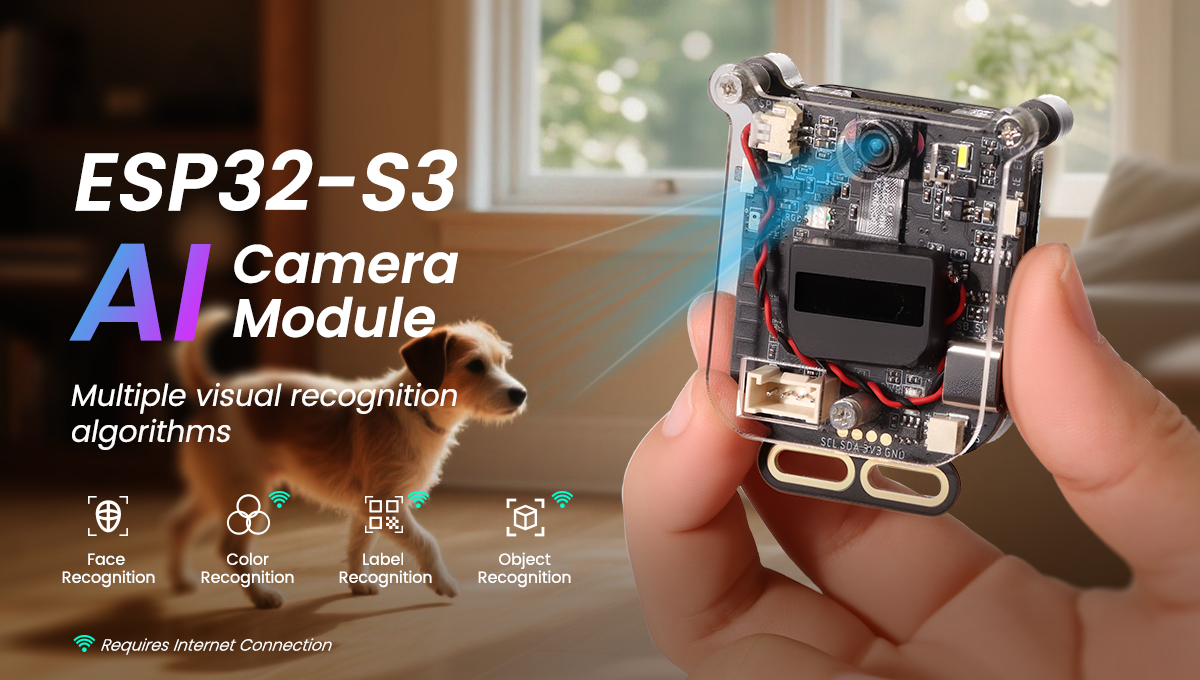
This AI Camera module, based on the ESP32-S3, integrates a 2MP camera, a 1.83" screen, a microphone, and a speaker, and comes pre-installed with face recognition, AI online image recognition, and voice intercom functions.
Description
What is an AI camera system?
An AI camera system combines traditional camera hardware with artificial intelligence (AI) software to perform intelligent functions beyond basic image capture. These systems can analyze images and video, and make decisions based on that analysis, often enhancing security, automation, and image quality.
Elecrow’s AI camera development board is an intelligent development board based on the AI camera system. It is a micro-intelligent development board that integrates multiple algorithms for recognition, and is designed for lightweight applications such as education, makers, and industrial recognition.
This AI camera uses ESP32-S3 low-power dual-core SoC, built-in WiFi+BLE communication function, and can support local AI recognition and cloud reasoning.
It is equipped with a GC2145 2-megapixel camera that can accurately recognize faces, objects, motion trajectories, etc. The TFT-LCD capacitive touch screen is easy to operate and can quickly switch recognition functions. The RGB lighting module can fill in the light for objects in the dark, and the MEMS microphone and speaker can be used for intercom and DIY voice commands.
The AI visual camera presets a variety of intelligent recognition algorithms such as face recognition, AI Online Image Recognition, and AI Online Voice Intercom, and is widely used in teaching experiments, smart car vision modules, industrial vision classification, and other scenarios.
It has UART and BAT interfaces, and can be linked and controlled with mainstream SBCs such as Arduino and Raspberry Pi, and has good expansion capabilities.
The compact design, rich external interface advantages, and broad market potential will redefine multimodal AI vision + voice interaction and redefine intelligent perception.
For more documentation, please visit the Wiki or GitHub.
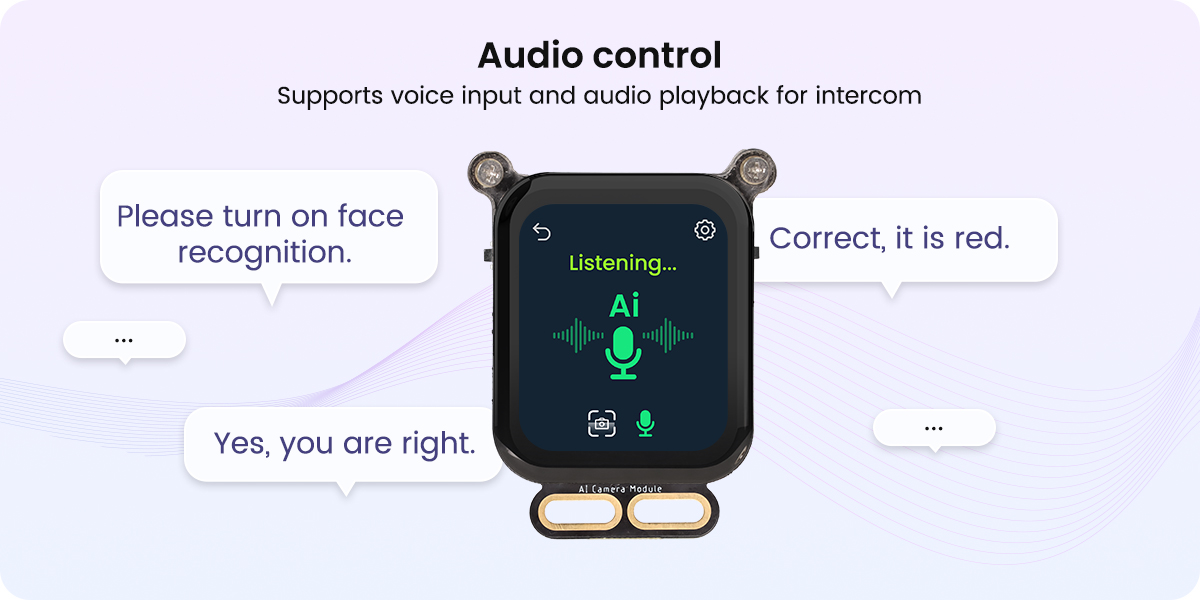
AI Camera supports audio control
It supports voice input and audio playback for the intercom.
Support Multiple Development Languages and Environments

The expansion interface can connect with multiple SBCs.
It can connect with Raspberry Pi, Audino, micro: bit, LattePanda, etc.


Hardware Overview


Feature
- Multiple visual recognition algorithms. Supports face recognition, AI Online Image Recognition, and AI Online Voice Intercom.
- Audio control. Supports voice input and audio playback, and can perform intercom and DIY voice control
- Multi-scenario interface. Reserved battery interface and UART, easy to connect to platforms such as Arduino and Raspberry Pi for linkage with other main controls.
- Ready to use. Built-in offline recognition model, can run as soon as it is turned on
- Wireless communication. Equipped with WiFi chip, real-time data upload, supports remote wireless control, and OTA update of recognition model data.
- Touch operation. Capacitive touch screen design can quickly switch between different recognition functions, easy to operate.
Who Needs This?
- Makerspace, programming training institutions, and hardware laboratories
- Enterprise users, industrial scenario test groups
- Primary and secondary school STEAM education and university scientific research teaching
Where is it used?
- STEAM education: learning visual recognition, image processing, and AI control
- Garbage classification demonstration: quickly identifying recyclables, hazardous materials, etc.
- Industrial identification: suitable for assembly line object recognition, label scanning, etc.
- Interactive experiment: programming and controlling peripherals with micro:bit and Raspberry Pi
Specification
|
Main Chip: ESP32-S3R8 |
|
|
Processor |
Equipped with high-performance Xtensa 32-bit LX7 dual-core processor, with a main frequency of up to 240MHz |
|
System memory |
8M PSRAM, 384KB ROM |
|
Storage |
16M Flash |
|
Development Language |
C/C++/MicroPython |
|
Development Environment |
ESP-IDF/Arduino/MicroPython etc. |
|
Wireless Communication |
|
|
Bluetooth |
Bluetooth®5, internal antenna |
|
WiFi |
WiFi 4 protocol, supports 2.4GHz, built-in antenna |
|
Image Sensor (Camera) |
|
|
GC2145 |
2.0Megapixels, 120-degree wide-angle |
|
Compatible cameras |
Compatible with OV2640/OV5640 |
|
Screen |
|
|
Size |
1.83 inch (Rounded Corners) |
|
Screen Type |
TFT-LCD |
|
Touch Type |
Capacitive Touch |
|
Resolution |
320*240 |
|
Audio |
|
|
Microphone |
MEMS microphone, sensitivity -26dB±1dB, signal-to-noise ratio 58dB |
|
Speaker |
8Ω/1W |
|
Hardware |
|
|
UART Interface |
4PIN UART serial port connector (pitch 2mm) |
|
BAT Interface |
2-pin battery holder (battery not included) |
|
Type-C Interface |
Power supply + program burning interface, input power 5V/1A |
|
Button |
RESET button, AI button |
|
LED Light |
Power indicator, White fill light, RGB Indicator, battery indicator |
|
Other |
|
|
Power Input |
5V |
|
Operating Temperature |
-20~70℃ |
|
Storage Temperature |
-30~80℃ |
|
Operation Power |
|
|
Size |
56*45*18.6mm |
|
Shell Material |
Acrylic |
|
Net Weight |
32g |
Package List
- 1x AI Camera Development Board
- 1x Type-C Cable
- 1x UART Serial Cable